
Prince George Scheduled Versus Actual Release
A scheduled or projected release date is the custodian's current calculation from the sentence and available credits. An actual release date records when custody ended or changed. Those dates can differ. A court may amend a sentence. The custodian may apply newly verified confinement credit, revise an earned-credit class, or impose a disciplinary loss. Another jurisdiction may take custody under a detainer, which is a request or legal hold for transfer. In that event, release from Riverside Regional Jail or VADOC is not the same as release to the community.
Pretrial status requires special care. A person awaiting a Prince George County case may have a bond hearing or future court date, but no sentence-based release date. The court can change bond, dismiss a charge, or enter a new order. RRJ's current locator only identifies people still in custody and does not publish a public release-date calculator. For a sentenced person, the sentencing order and official custodian computation are the starting records.
Scheduled versus actual: A future date may change. Confirm completion with the RRJ or VADOC release entry and the Prince George court record.
Find Prince George Projected Release Dates
Begin by identifying who holds the person and what kind of sentence applies. Riverside Regional Jail is the local adult custodian for Prince George County. VADOC computes state-responsible sentences and publishes the Inmate and Supervisee Locator. The locator accepts the first three letters of the first name plus the full last name, or a seven-digit DOC ID. It also offers location, race, gender, and age-range filters. The person must be matched by more than a common name.
The VADOC detail may show a scheduled or projected release date for someone under state custody. Transcribe the label exactly and save the lookup date because VADOC says the locator updates daily while warning that data can be inaccurate or old. A fully discharged person may not remain searchable. In that case, the Prince George County release-record process explains how to request the custodian's completed record.
- Read the court docket and sentencing order to separate pretrial detention from an active local or state sentence.
- Check RRJ for present local custody, then ask RRJ for the official calculation when a local sentence controls.
- Search the VADOC locator when the person is state-responsible or under state supervision, and record the displayed date label.
- Compare the result with the sentence, jail credit, parole status, and any later court order.
- After the date passes, verify the exit with release papers, a custody-change notice, or a targeted records request.
Note: A missing VADOC result may reflect full discharge or a search mismatch; it does not supply an actual release date.
Prince George Release Date Computation
The administrative estimate starts with each sentencing order's active term. The responsible authority then applies qualifying credit for time already spent in confinement under Virginia Code § 53.1-187. Next it determines whether the term is local-responsible or state-responsible and which statutory credit system applies. Concurrent sentences run together to the extent ordered. Consecutive sentences run one after another. Revocation time, amended orders, escape periods, and legal holds can change the working total.
Classification matters because the same charge label does not answer every input. The offense date determines which version of Virginia law applies. The final order controls the active term, while jail records establish qualifying days actually spent in confinement. A later revocation can add suspended time. Program participation and conduct can change an earned-credit level. For that reason, a calculation copied from someone else's case is not a sound Prince George County release estimate.
The VADOC time-computation source explains which rules and authorities govern the calculation. Its official summary is shown in the captured image below.
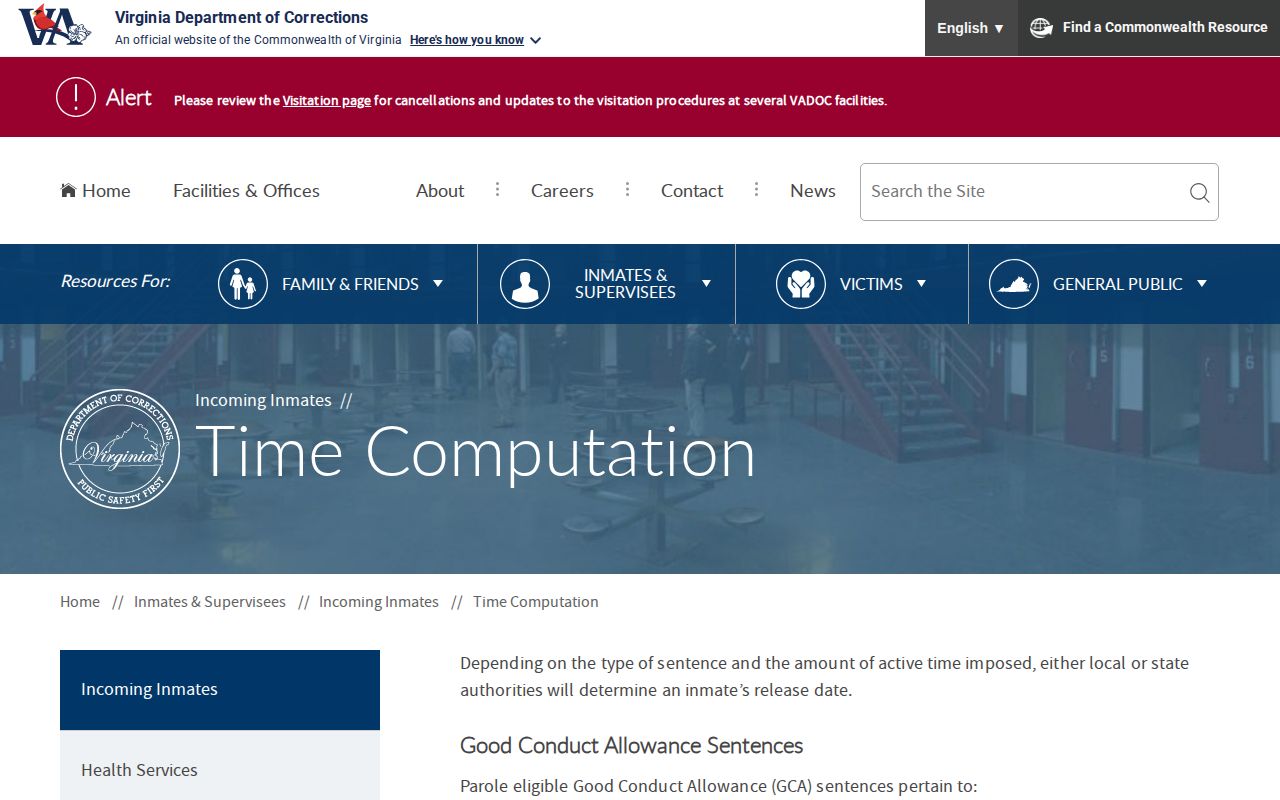
The source separates older Good Conduct Allowance cases from Earned Sentence Credit cases, which is why one broad percentage cannot calculate every Prince George County release date.
| Input | How it can affect the date |
|---|---|
| Sentencing order | Sets active time and whether terms run together or in sequence |
| Confinement credit | Credits qualifying time already served under the controlling order and law |
| Earned-credit class | Changes deductions based on eligibility, conduct, and program criteria |
| Discipline or recalculation | May reduce credit or correct an earlier computation |
| Court amendment or revocation | May change active time after the first calculation |
| Detainer or transfer | Can change destination even when one custodian releases the person |
Prince George Earned Release Credits
For covered felony offenses committed after the older-law cutoff, Virginia Code §§ 53.1-202.2 and 53.1-202.3 govern Earned Sentence Credit eligibility and rates. One credit equals a one-day deduction. Current law keeps a restricted rate for an enumerated set of offenses. Other eligible offenses may earn by classification: Level I allows 15 days per 30 served, Level II allows 7.5, Level III allows 3.5, and Level IV allows zero, subject to statutory conduct and program rules.
The phrase “serve 85 percent” describes the classic truth-in-sentencing baseline for many no-parole terms, where the maximum deduction was 4.5 days per 30 days served. It still helps explain restricted-credit sentences. It is not a universal formula. Enhanced rates, offense lists, effective dates, sentence combinations, and the person's real classification can produce a different result. Virginia Code § 53.1-165.1 also abolished ordinary discretionary parole for covered felonies committed on or after January 1, 1995.
Older parole-eligible Good Conduct Allowance sentences use another framework. VADOC describes class rates from zero through 30 days per 30 served and computes parole eligibility, mandatory parole, and good-time release for qualifying combinations over 12 months. Sections 53.1-199 through 53.1-201 and § 53.1-151 may apply. Credits do not always advance parole eligibility. Use the sentence date, offense, and official calculation rather than an online calculator.
Prince George Local Jail Release Dates
Virginia Code §§ 53.1-116 and 53.1-129 give sheriffs and regional jails roles in local good-conduct credit and allowance. Riverside Regional Jail's official computation controls a Prince George County local sentence. RRJ does not publish a public calculator or a standard public pickup time. A family estimate based only on the sentence length can miss jail credit, court changes, another charge, or a detainer.
Ask for the existing record tied to the correct booking. Useful identifiers include full name, date of birth, approximate booking dates, booking number if known, Prince George arresting or committing agency, court, and case number. Request the calculated release information or completed release entry that can lawfully be provided. The final record may show a community exit, transfer to VADOC, transfer to another jurisdiction, or another legal disposition.
RRJ serves seven localities. A name in that regional jail therefore does not show that the sentence came from Prince George. Confirm the arresting or committing agency and the originating court before asking for a computation. A person may also be held at RRJ under VADOC authority. In that setting, the VADOC locator and RRJ record can describe different parts of the same custody period, so the status and authority fields must be reconciled.
A juvenile at Crater Juvenile Detention Center follows confidential court and DJJ channels. Adult RRJ and VADOC tools cannot establish a youth's projected or actual release. An authorized parent, attorney, court contact, or Court Service Unit 6 is the correct route.
Prince George Parole Date Effects
A parole eligibility date is the first point when the Board may review an eligible person. It is not a promised release. The Virginia Parole Board's monthly report can show a grant or denial, but VADOC implements any later release after planning and conditions. A meeting agenda shows that a matter may be considered, not that the person left prison.
For a parole-eligible Prince George County case, follow a record chain: statutory eligibility and VADOC time computation, Board meeting or monthly action, VADOC scheduled date, signed release papers, and later supervision status. If the question concerns community supervision after release, the Prince George County parole and probation record distinguishes the Board's decision from VADOC's active supervision and eventual discharge.
Note: A parole grant can precede the actual exit while VADOC completes conditions, plans, and any other required review.
Prince George Release Timing Rules
Two Virginia rules answer different timing questions. VADOC's facility-release process says a person leaving a state facility on discharge or parole will be released by 11:59 p.m. on the release date, weather permitting. Virginia Code § 53.1-28 separately addresses certain local-prisoner releases when the final date falls on a Saturday, Sunday, or legal holiday. Neither source proves that RRJ offers a standard pickup hour.
The VADOC statewide process and its release documents appear in the official source captured below. Review the VADOC facility-release source for the current operational language.
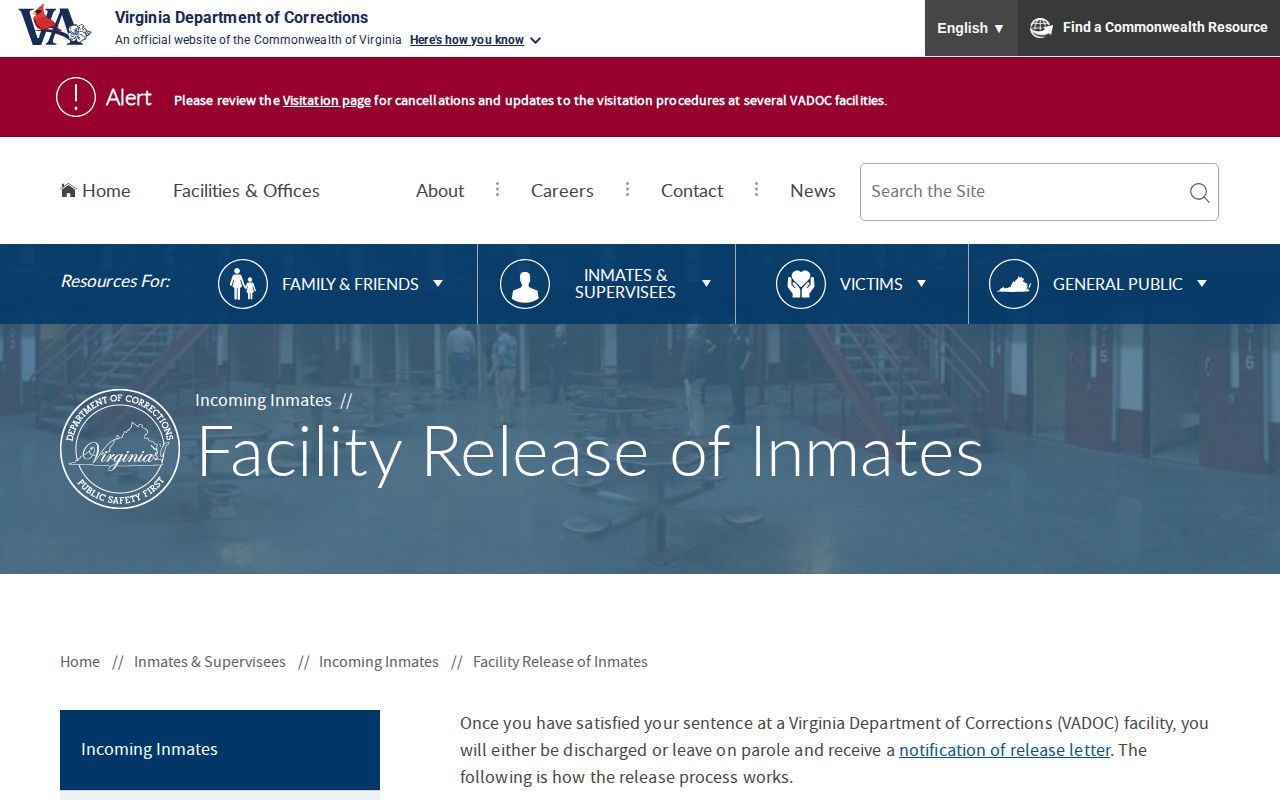
The statewide deadline belongs to a VADOC discharge or parole release. It should not be copied onto a local RRJ estimate or treated as a guaranteed family pickup time.
Section 53.1-28 is also narrower than a general weekend promise. Its application depends on the type of local sentence and the terms in the current statute. A date that falls on a holiday should be confirmed with RRJ and the sentencing court. Weather, transport, paperwork, or a receiving agency can affect the physical handoff even when the legal date is settled.
Confirm Prince George Actual Release
After the projected date passes, obtain retrospective evidence. For RRJ, request the admission and release dates, release time, release authority, release type, and receiving agency or destination where releasable. Pair that jail entry with the Prince George court docket or final order. For VADOC, the strongest papers include the Order of Release, Conditions of Probation or Parole, and notification-of-release letter signed or issued through the facility process.
Virginia VINE can provide a custody-change alert, but it is not a certified historical record and may lag the agency feed. A “released” event means release from the reporting custodian. Another jail, VADOC, BOP, or ICE may take custody next. The Prince George County projected release date is therefore complete only when the date, legal authority, custodian, and destination all agree.
Keep the original scheduled result as well as the final record. The difference can explain whether credit changed, the court amended the term, parole altered the path, or a transfer followed. A dated VADOC locator capture supports the estimate that was displayed at that time. The signed release documents or RRJ release entry establish the later event, and the court docket supplies the legal basis.