
Crater Youth Release Privacy
Crater Juvenile Detention Center is a regional youth facility in Disputanta. It serves Prince George County and other participating localities, and Virginia's Department of Juvenile Justice identifies Crater among centers used for individual-bed placements. That role does not make youth placement or release data an adult public roster. Juvenile names, photos, case facts, and movement details generally remain confidential.
Public adult tools are the wrong route. Riverside Regional Jail's locator covers people in its adult custody. The VADOC locator covers adult state custody and supervision. A public adult booking-photo request also does not open a juvenile file. Commercial listings and casual social posts are not a valid substitute for an authorized juvenile source.
An authorized parent, guardian, attorney, or other person recognized by the court or agency should use the case-specific contact route. Others may be told only that the information is confidential. That limit protects the young person and avoids a false claim based on an adult database that never covered Crater.
Crater Youth Release Outcomes
Leaving Crater does not always mean an unrestricted return to the community. A youth may return to a parent or guardian under a court order. The court may order a treatment or residential placement, juvenile probation or parole, direct care through DJJ, or another authorized placement. A physical move can therefore continue legal custody or supervision.
| Possible outcome | Who may confirm |
|---|---|
| Return to parent or guardian | Authorized family, attorney, or JDR court |
| Juvenile probation or parole | DJJ Court Service Unit and court order |
| DJJ direct care | Authorized DJJ channel |
| Other court placement | JDR court, counsel, and assigned agency |
The exact words in the juvenile court order control. “Released from Crater” describes the end of that facility stay, not necessarily the end of the case, state care, placement rules, or supervision. A parent or attorney should ask whether the youth was discharged, transferred, placed, or returned home rather than treating every departure as the same event.
Confirm Crater Youth Release
The correct route begins with authority to receive the information. The Prince George Juvenile and Domestic Relations District Court, Crater staff, and DJJ Court Service Unit 6 are the relevant institutional channels. An attorney or recognized family member can use the case number and identity details that the agency permits.
- Confirm that the inquiry concerns Crater in Disputanta, Virginia, not an adult jail or another similarly named place.
- Gather the juvenile case number and the contact information already recognized in the case.
- Contact counsel or the Prince George JDR court for the controlling order and the correct agency contact.
- Use Crater or CSU 6 only through an authorized path and ask whether the event was return, placement, transfer, or supervision.
- Follow privacy directions for any written record or verbal confirmation received.
A public court portal may omit juvenile information. That is expected and does not establish whether a youth is present, released, or moved. Staff may require identity and authority checks before giving any case-specific response. Those checks are part of the lawful process, not a sign that an adult locator should be tried instead.
Crater Release Contact Channels
Crater's public contact can route an authorized inquiry, but the general phone line is not a public youth roster. Give staff only the facts needed to identify the proper process. Do not ask the facility to publish a name or confirm a private case to someone without authority.
Crater Juvenile Detention Center4200 County Drive
Disputanta, VA 23842
Phone: 804-733-2760
CSU 6 serves Prince George and lists a county branch through its official directory. The court service unit handles juvenile intake, probation, parole, and related court services within its role. The court remains the source for the order. Crater remains the source for its facility function. DJJ remains the state juvenile agency. Keeping those roles separate prevents a facility departure from being mislabeled.
The official CSU 6 page is a useful source for current agency routing.
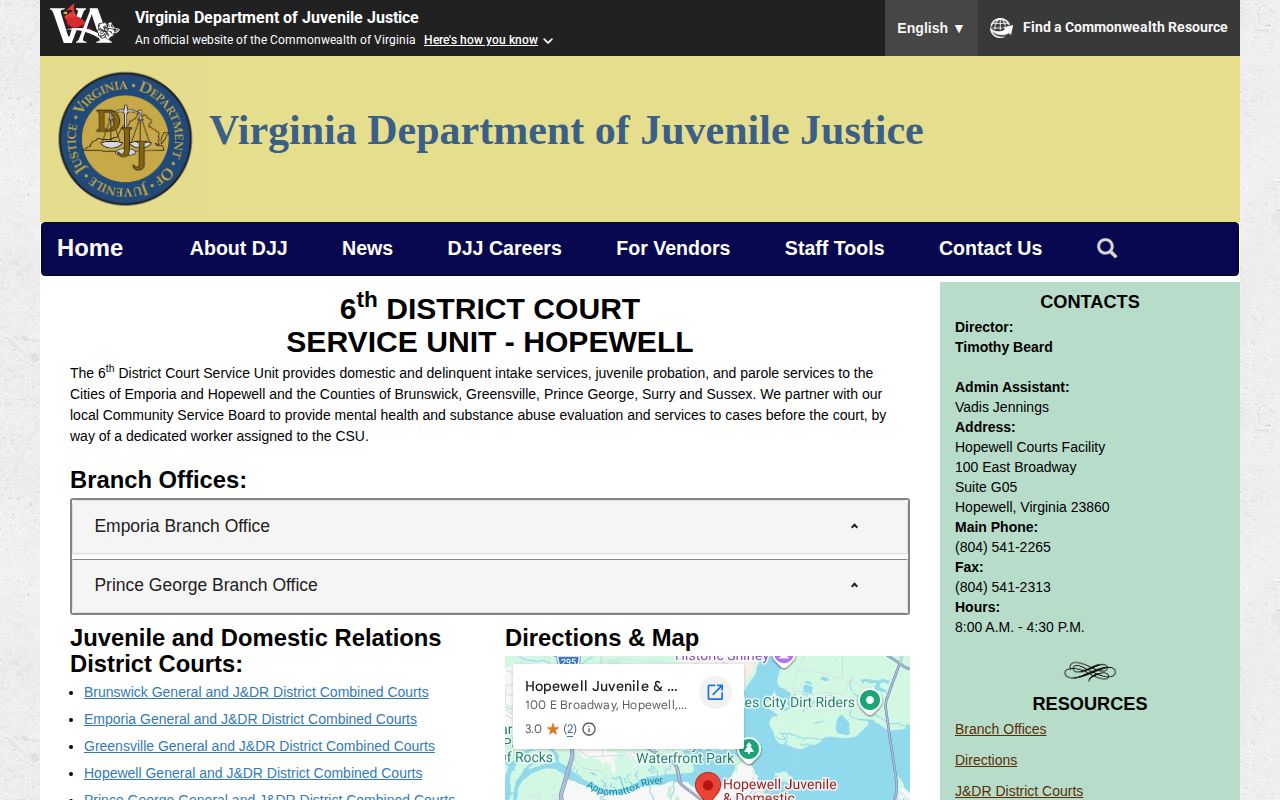
The DJJ source ties Prince George to the correct juvenile service district without exposing a youth's name, case, or placement.
Crater Juvenile Release Records
Juvenile records have a different access boundary from adult jail records. Virginia law restricts juvenile court and detention material. The adult booking-photo disclosure rule does not turn a youth intake image into a public record. Sealed information, medical facts, victim data, treatment details, and protected case material also remain outside an open adult-record process.
An authorized requester should ask for the particular order, notice, or agency record that the requester is entitled to receive. The request should identify the youth and case through the secure method the court or agency directs. Broad requests for a “released youth list” conflict with the facility's confidential role and are not supported by the research.
The same limit applies to photographs. Virginia's adult initial-intake booking-photo rule is specifically about adults and cannot be used to demand a juvenile image. A photo copied from an old post does not prove current identity, custody, placement, or release. Authorized participants should rely on the court and juvenile agency record, keep the material within the permitted circle, and follow any direction about storage or further disclosure.
Confidentiality also changes how a search failure should be understood. An adult search system may return nothing because it was never designed to contain the youth. A public court portal may omit the matter because juvenile access is restricted. Neither absence establishes a date, destination, or legal status. Only an authorized response tied to the correct case can supply that meaning.
- Juvenile probation
- Court-ordered community supervision for a young person.
- Juvenile parole
- Supervision after release from eligible DJJ direct care.
- Direct care
- State juvenile custody or placement administered by DJJ.
- Placement
- A court-authorized living or treatment setting that may follow detention.
Note: Permission to receive one case record does not authorize public republication of the young person's identity or private details.
Petersburg Facilities in Prince George
Crater sits in the same county landscape as institutions whose names can blur agency lines. FCI Petersburg Low and Medium use Hopewell postal addresses but are federal prisons physically located in Prince George County. Riverside Regional Jail is the regional adult jail. Crater is the regional juvenile center. Each has a separate operator, population, record system, and release path.
The “Petersburg” label on a federal institution does not place a youth in federal custody. Likewise, Crater's Prince George relationship does not make it part of RRJ or VADOC. BOP handles federal release results, RRJ handles its adult local records, and DJJ plus the juvenile court handle authorized youth matters. The physical closeness of the facilities changes none of those custodial rules.
The DJJ individual-bed placement information confirms Crater's juvenile role. It does not provide a name search, and it should not be used to infer that any specific youth is detained or released.
Individual-bed placement also explains why a youth's next location cannot be guessed from a Prince George address. A court or DJJ decision may direct another approved setting, and the public facility list does not disclose who occupies a bed. The assigned attorney, recognized family contact, or agency worker can explain the lawful next step to an authorized person.
Avoid Crater Release False Matches
Search terms can pull results from the wrong county, state, or custody system. Prince George County, Virginia is often confused with Prince George's County, Maryland. “Riverside” may point to California. “Petersburg” can mean the independent Virginia city or the local federal complex. Add “Crater Juvenile Detention Center,” “Disputanta,” “Virginia,” and “DJJ” when locating an official public contact page.
Even the correct official page will not provide an adult-style youth roster. That absence is a privacy feature, not evidence of release. Never use a failed RRJ, VADOC, BOP, or general web search to tell a family that a youth has left Crater. Only the authorized court, facility, counsel, family, or DJJ channel can confirm the event and its legal meaning.
The Prince George County custody-system overview can help distinguish adult local, state, federal, immigration, and juvenile routes. Case-specific youth details must still remain within the authorized juvenile channel.