
Prince George Parole Versus Probation
Parole and probation both place conditions on a person in the community, but they begin in different ways. Probation is imposed by a judge, either instead of active incarceration or after a jail or prison term. Parole is a conditional release authorized through the Virginia Parole Board for a person who is legally eligible. Virginia abolished ordinary discretionary parole for most covered felony offenses committed on or after January 1, 1995. Older cases and certain statutory groups may still qualify. Eligibility means the Board may review the case. It does not promise a grant or a release date.
Prince George County also has forms of oversight that are neither state parole nor state probation. The Riverside Criminal Justice Agency provides local probation and pretrial services for Prince George, Hopewell, and Surry. Juvenile probation and parole run through Virginia Department of Juvenile Justice Court Service Unit 6. Federal supervised release is handled through the federal court system. The court order, release papers, and custodian identify which track applies.
| Status | Who orders it | Where to verify |
|---|---|---|
| State probation | Virginia court | VADOC locator, conditions, and court order |
| State parole | Virginia Parole Board | Board decision, VADOC record, and parole conditions |
| Local probation or pretrial | Local court placement | Prince George court record and Riverside Criminal Justice Agency |
| Federal supervised release | Federal court | Federal judgment and U.S. Probation |
Verify Prince George Post-Release Supervision
The VADOC Inmate and Supervisee Locator covers people in Virginia state institutions and people supervised by district offices. It also covers some people in local or regional jails under VADOC authority and Community Corrections Alternative Program participants. Search with the first three letters of the first name and the full last name, or use the seven-digit DOC number. Optional filters include location, race, gender, and age range. VADOC says the locator updates daily, yet its disclaimer warns that information may still be inaccurate or old.
A careful Prince George County supervision check uses more than one screen. Keep the search date and compare the returned identity, status, and office with the court or release papers. Someone may leave a prison and still appear as a supervisee. Someone who completed both custody and supervision may no longer appear. The full Prince George County released-inmate search path explains how a custodian record and court order can confirm the earlier release event.
- Identify whether the case is state, local, juvenile, or federal from the sentencing court and releasing custodian.
- Search the VADOC locator when state custody, probation, or parole is plausible, then match the person with more than a shared name.
- Read the final court order and any signed Conditions of Probation or Conditions of Parole.
- For parole, check the Board's monthly decision report, then confirm implementation through VADOC.
- Use the office shown in the person-specific record, not a nearby office chosen by geography alone.
Note: A Parole Board grant records a decision, while VADOC release papers and supervision records establish what happened afterward.
Prince George Parole Decision Records
The Virginia Parole Board decides parole for people who remain eligible under Virginia law. Since July 1, 2024, the Board must hold a public meeting for final deliberation and voting on whether to grant parole. Not every eligible person appears on a public meeting agenda. The public-meetings page posts an agenda when a meeting is set and keeps approved or draft minutes by date. Its cadence is event-based, not a fixed weekly list. Outcome research belongs in the Board's monthly decision reports. Open the PDF for the likely month, search by name or DOC number, and check every identifier supplied. “Grant” means the Board approved parole within its process. VADOC must still finish release planning and conditions before the physical exit. “Not grant” or “denied” means no parole release from that review. A violation action, deferral, continuation, or rescission must be read in its own report or minutes.
Virginia Code § 53.1-151 supplies the older-law baseline. A first felony commitment generally reaches eligibility after one-quarter of the term, capped at 12 years when one-quarter is longer. The second scale is one-third or 13 years, the third is one-half or 14 years, and the fourth or later scale is three-quarters or 15 years. The statute has exclusions, life-sentence rules, and offense-specific provisions. Those figures help locate a possible review point, but only the official time computation establishes eligibility in one case.
The official Parole Board site shows where that decision process begins. View the Virginia Parole Board source before consulting the captured page below.
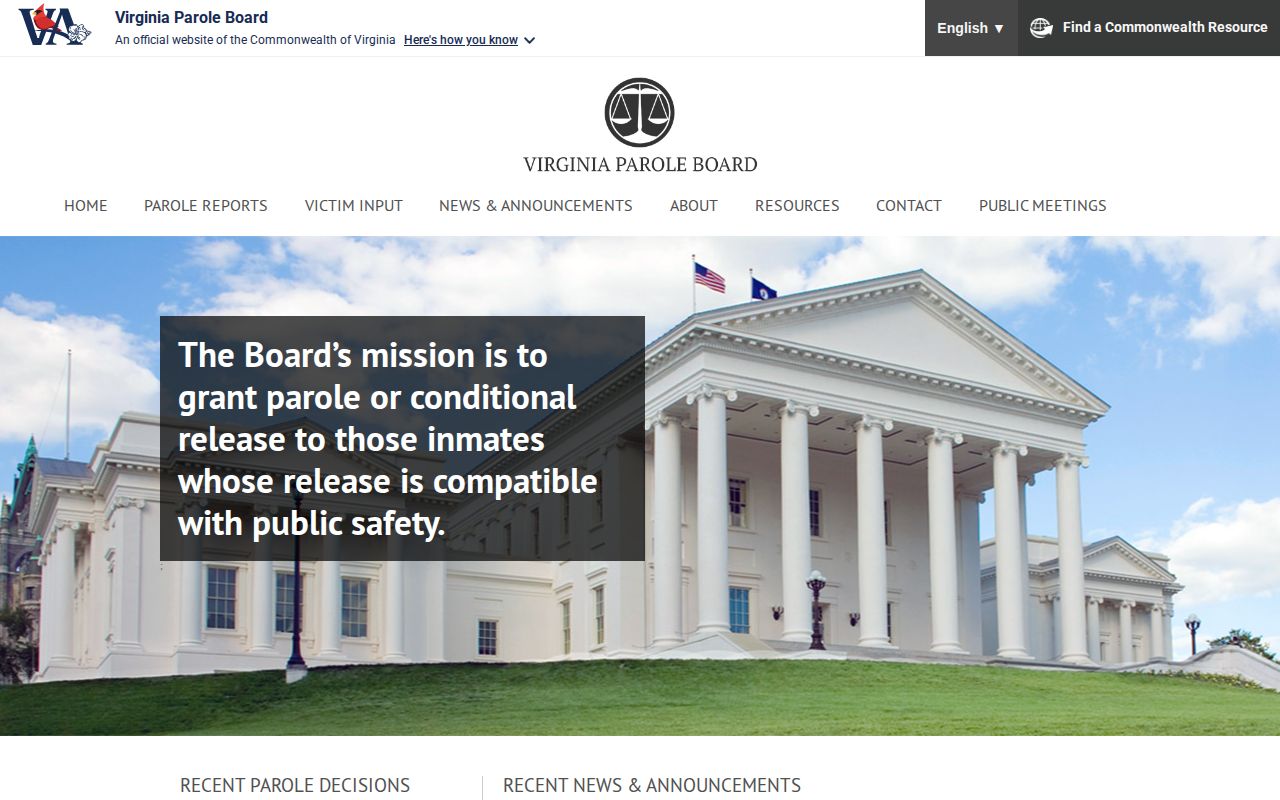
The image identifies the state decision agency, but it does not replace a monthly decision, VADOC release record, or current supervision entry for one person.
Prince George Probation Office Lookup
The nearby Petersburg district office should not be assumed to supervise every Prince George County case. VADOC's public directory does not clearly name Prince George in the displayed service-area text for that office. The safer route is the district information shown on the VADOC locator, the signed conditions, or the release order. If those sources conflict or omit the office, use the VADOC facility and office directory or central contact and ask which district holds the case.
The central address and number provide a verified starting point without guessing an individual officer's location or schedule. Do not send private case facts to an office selected only because it is close to Prince George County.
Virginia Department of CorrectionsP.O. Box 26963
Richmond, VA 23261
804-674-3000
Central contact for office routing
For a local probation or pretrial placement, use the Prince George court order and Riverside Criminal Justice Agency instead. Its service area includes Prince George, Hopewell, and Surry, and its placements can come from General District, Juvenile and Domestic Relations, or Circuit Court.
Prince George Supervision Terms Defined
Words used in release and supervision records have precise roles. They should not be treated as labels for the person. A short definition check helps reconcile a court docket, a VADOC locator result, and an agency notice.
- Parole
- Conditional community release approved for a person who qualifies for review under the applicable Virginia law.
- Probation
- Court-ordered supervision in the community, sometimes imposed after active time and sometimes instead of it.
- Discharge
- The formal end of custody, supervision, or both, as stated in the controlling agency record.
- Absconder
- A person officially alleged to have stopped reporting or left supervision, not merely someone missing from a public search.
- Capias
- A court-issued order directing that a person be taken into custody, often visible in a case docket.
Release and discharge are not interchangeable. A person may be released from a facility while probation or parole continues. Full discharge may come later. When a locator stops returning a person, request the releasable VADOC discharge record or consult the final supervision order instead of assigning a status from silence.
Prince George Supervision Violation Checks
No Prince George County parole or probation absconder list was found. VADOC's statewide “Most Wanted” material is selective, not a full list of every alleged violation. A missed locator result or an online claim does not establish that a person absconded. The official case may instead show that supervision ended, moved to another district, or changed after a court order.
For a suspected violation, inspect the Prince George court case for a capias, revocation hearing, or later order. A revocation is the court or Board process that reviews an alleged breach and may alter the supervision terms or impose suspended time. VINE can send custody-event notices, but it is not a complete supervision-violation docket. Confirm any claimed warrant through the court or responsible agency before relying on it.
Important: Never call someone an absconder from a missing search result. Use an official warrant, court entry, or supervision record.
Prince George Release Reentry Resources
Riverside Regional Jail maintains a reentry resource page organized by member locality. Its Prince George block identifies the local health department at 6450 Administration Drive and 804-733-2630. The same RRJ page points readers to 211 Virginia and the 988 crisis line. These are practical community contacts tied to the regional jail's actual Prince George service area.
Reentry help and supervision serve different functions. A resource listing does not prove eligibility, guarantee an appointment, change conditions, or approve travel. A person under Prince George County post-release supervision should compare any program plan with the signed probation or parole terms. When a condition requires approval, the supervising agency remains the source for that decision.
Note: RRJ's Prince George resource block is a referral starting point, not proof that a service will accept a person.
Prince George Supervision Discharge
Supervision ends through an official discharge, expiration, or court or agency action under the controlling case. It does not end because the person moved, stopped appearing in a web result, or finished the jail portion of a sentence. For parole, the Board and VADOC records may both matter. For state probation, the court order, VADOC case record, and discharge document establish the result. For local probation, consult the Prince George court and Riverside Criminal Justice Agency record.
Virginia Code § 53.1-136 requires publication of statements of Parole Board action, but a published decision is only one point in the chain. A sound Prince George County parole verification follows eligibility and Board action to VADOC's release papers, active supervision status, and eventual discharge. Keep each dated record. That sequence distinguishes a favorable vote, a facility release, a term of community supervision, and the final end of state control.
Notification records can supplement that chain. Virginia Jail VINE covers participating local-jail events, while VADOC VINE covers state-corrections events, and each requires its own registration. A notice may report a release or custody change. It does not prove the court ended probation or that VADOC entered final discharge. Use the notice to identify when to check, then obtain the controlling record.